

Wheel of Life
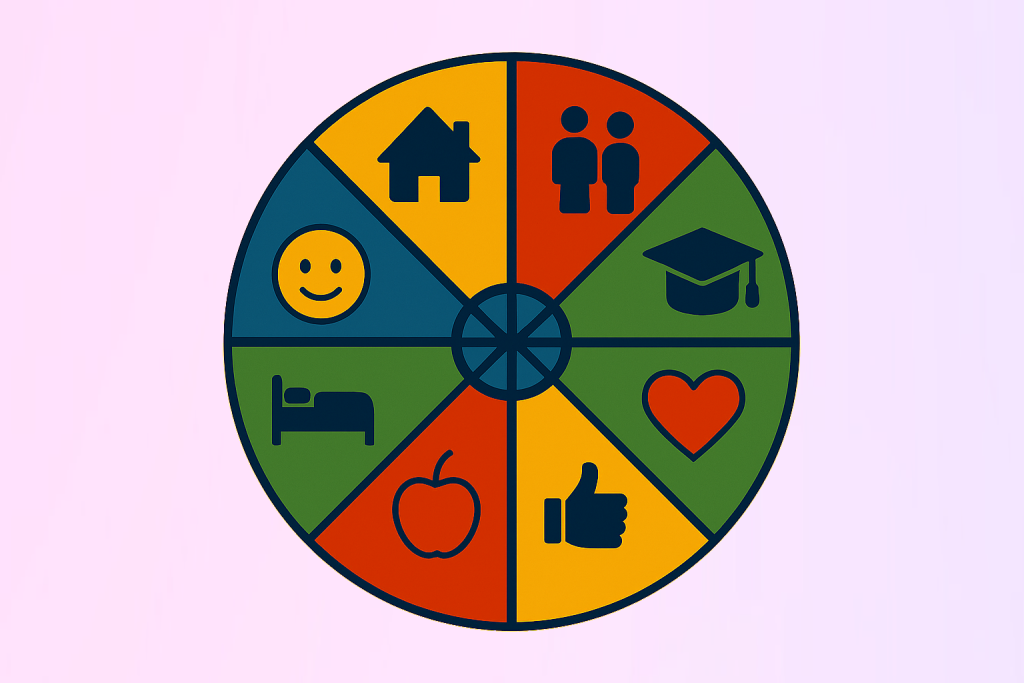
Purpose: This tool makes it easy for participants to show how they feel about a particular This tool helps participants visually reflect on how balanced or unbalanced different areas of their lives currently feel. By scoring key life domains and mapping them on a wheel, participants can quickly identify areas of stability, imbalance, and potential strain.
The method is simple, accessible, and adaptable. It can be used as:
- an individual reflection tool,
- a structured discussion starter,
- a foundation for goal-setting and group dialogue.
Pilot experience in Ukraine and Serbia. Across both Ukrainian and Serbian pilots, the Wheel of Life proved to be a highly effective tool for translating abstract emotional states into a clear and structured visual format. In Ukraine, participants often experienced uncertainty, stress, and emotional overload due to external factors (including war-related challenges). The tool helped them move from a generalized feeling of “everything is difficult” toward a more structured understanding of their life situation. In Serbia, the tool was used within a broader sequence of workshops on self-awareness and emotional intelligence. It contributed to deeper reflection, helping participants identify strengths, weaknesses, and areas for personal growth, while also supporting confidence-building and goal-setting.
In both contexts, the visual and structured nature of the tool:
- reduced pressure to verbalize emotions immediately,
- supported gradual engagement,
- encouraged deeper and more meaningful discussions.
The intended change in both pilots was not to immediately «solve participants» problems, but to create space for reflection and structuring personal experiences. In Ukraine, the tool helped participants differentiate between stable and vulnerable areas of life, making discussions more constructive and less emotionally overwhelming. In Serbia, the tool supported participants in identifying personal development goals and increasing self-confidence through structured reflection and complementary activities (e.g. Letter to Myself).
Issue addressed: Self-awareness, stress management, emotional overload, reduced sense of control, difficulty prioritizing, and lack of balance between key life areas such as study, rest, relationships, safety and personal development.
Relevance to mental health: The tool supports mental health promotion by helping participants notice early signs of imbalance before they escalate into stronger distress. It encourages emotional literacy, self-observation and realistic self-assessment. It also strengthens a sense of agency: instead of seeing wellbeing as something vague or unreachable, participants identify specific domains that influence their mental state and discuss what small actions could improve them.
Intended change: Participants gain a clearer understanding of their current life balance, identify one or more areas that need support or change, and leave the session with a more grounded sense of priorities and manageable next steps.
Ukrainian pilot experience. In the Ukrainian pilot, the intended change was not to “solve” participants’ problems in one session, but to help them pause, reflect and organize their experience. The tool supported participants in moving from a general feeling of “everything is difficult” toward a more differentiated understanding of what exactly feels stable and what feels fragile. This often made follow-up discussion more constructive and less emotionally chaotic.
Context of pilot implementation
This tool was piloted in two countries as part of the MEET project. These included Ukraine engaging 93 young participants (including 87 unique individuals) across pilot activities, and in Serbia, with a total of 45 young participants involved.
Ukrainian pilot experience. The Wheel of Life tool was piloted in Ukraine by NGO “Youth Space” within the MEET project in youth-friendly educational and non-formal learning settings in Zakarpattia. It was used with adolescents and young people in small and medium-sized groups during sessions focused on wellbeing, self-reflection, stress, future planning and personal resources. The Ukrainian context shaped the facilitation strongly. Young people often reflected on life under prolonged war-related uncertainty, disruption of routines, academic pressure, family strain, internal displacement, safety concerns and reduced predictability regarding the future. Because of this, the tool was adapted so that the selected domains spoke directly to participants’ lived reality rather than to an abstract ideal of a “balanced life”. During the pilot, facilitators used the Wheel of Life both as a diagnostic entry point and as a reflective exercise in the middle or toward the end of a session. The most common focus areas were emotional wellbeing, rest and recovery, family and peer support, learning or work, safety and stability, and opportunities for self-development. The pilot showed that the tool works especially well when participants first complete the wheel individually and only afterwards share insights voluntarily in pairs, small groups or plenary discussion. This sequencing preserved psychological safety and allowed more genuine reflection.
Serbian pilot experience. The Wheel of Life tool was piloted in Serbia by Know How Centre (KHC) within the MEET project in structured workshop settings focused on psychosocial literacy, self-awareness, and life skills development. It was used with young people, including NEET participants, in small and medium-sized groups as part of a broader sequence of sessions addressing stress, emotional awareness, coping strategies, and personal development. The Serbian context shaped the facilitation through a strong emphasis on building emotional literacy, self-confidence, and practical life skills. Participants engaged in a series of interconnected workshops where topics such as stress management, emotional expression, and decision-making were gradually introduced and deepened. Within this framework, the Wheel of Life was positioned as a tool for integrating prior learning and translating it into a structured self-assessment of one´s life situation. During the pilot, facilitators used the Wheel of Life primarily in the later stages of the learning process, as a reflective and consolidating exercise. It allowed participants to assess different life domains, identify imbalances, and connect these insights with previously explored topics such as stress triggers, emotional responses, and coping strategies. The activity was often complemented by follow-up exercises, such as individual reflection tasks (e.g. Letter to Myself), which supported goal-setting and personal development planning. The most common focus areas included emotional wellbeing, self-confidence, relationships, personal development, decision-making, and everyday functioning. Unlike a purely diagnostic use, the tool in Serbia functioned as a bridge between reflection and action, helping participants not only to understand their current situation but also to define concrete steps for improvement. The pilot showed that the tool works especially effectively when embedded within a broader learning trajectory. Participants first developed a basic understanding of emotions and stress, then practiced self-reflection through various activities, and finally applied the Wheel of Life as a structured synthesis of their learning. This sequencing increased participants’ confidence, depth of reflection, and willingness to share personal insights. At the same time, facilitators observed that combining individual work with group discussion enhanced both personal insight and peer learning. Participants who were initially hesitant became more open over time, and the structured nature of the tool helped create a safe and supportive environment for sharing experiences and perspectives.
Target group
- Age: 12 years and above
- Profile: adolescents and young people, including NEETs and youth with diverse social and educational backgrounds
- Context: non-formal and formal education; applicable in small and medium-sized groups, as well as adaptable for larger groups
Context of use
Location: schools, NGOs, youth centres, community spaces, outdoor learning environments, and outreach settings
Duration: 30–60 minutes (depending on depth of reflection and discussion)
Types of skills and dimensions addressed:
- Socio-emotional skills: development of emotional awareness, understanding stress, and recognizing personal needs and resources
- Relational skills: strengthening communication, empathy, and the ability to understand others’ perspectives through shared reflection
- Self-regulation skills: identifying imbalance and developing strategies for emotional regulation and stress management
- Awareness skills: increasing awareness of one’s own life situation, priorities, and factors influencing wellbeing
- Participatory and expression skills: encouraging independent reflection, gradual sharing of personal insights, and active participation in group discussions in a safe and respectful environment.
Ukrainian and Serbian pilot experience. The pilots in both countries confirmed that the Wheel of Life is most effective when used as part of a broader learning and reflection process.
In Ukraine, the tool was often used in sessions focused on wellbeing, stress, and future planning, where it helped participants connect emotional experiences with specific life domains. It supported awareness of imbalance and enabled participants to reflect on how external factors (such as uncertainty and disruption) influence their lives.
In Serbia, the tool was integrated into a structured sequence of workshops addressing stress, emotional literacy, and personal development. It functioned as a synthesis tool, allowing participants to connect previously learned concepts (e.g. stress triggers, coping strategies) with their own life situation and translate reflection into concrete personal goals. In both contexts, facilitators observed that the tool:
- Enhances the depth of reflection when combined with prior activities,
- Supports the transition from awareness to action,
- Encourages participants to move from general feelings to specific insights and decisions.
Ukrainian and Serbian pilot experience. In both the Ukrainian and Serbian pilots, the tool proved to be highly adaptable to different group compositions and learning environments. It was effectively used with adolescents and young people, including participants with varying levels of confidence in self-expression and prior experience with reflective exercises.
In Ukraine, the tool was particularly suitable for groups experiencing emotional stress and uncertainty, as it provided a structured and non-intimidating way to reflect on personal wellbeing. Participants who initially found it difficult to articulate their feelings benefited from the visual format, which allowed them to express themselves without immediate verbalization.
In Serbia, the tool was used with young people, including NEET participants, within a structured learning process focused on psychosocial skills. It proved effective for participants with different levels of engagement, including those who were initially less confident or hesitant to participate in discussions. The structured nature of the tool supported gradual involvement and increased openness over time.
Across both contexts, the tool worked particularly well when facilitators aimed to:
- create a safe entry point for self-reflection,
- engage participants who might otherwise remain passive,
- balance individual reflection with group interaction.
Activity description – step by step
Step 1: Preparation.
Facilitators prepare the Wheel of Life template (printed or digital) and define the life domains to be assessed. These can include, for example: emotional wellbeing, health, relationships, education/work, rest, safety, personal development, and finances. The selection of domains should be adapted to the context and needs of participants. In Ukraine, domains were often adapted to reflect real-life challenges such as safety, stability, and emotional wellbeing in conditions of uncertainty. In Serbia, domains were aligned with topics already explored in previous sessions, such as emotional awareness, stress, self-confidence, and personal development.
Facilitators should also:
- Prepare a short explanation of the tool,
- Ensure a safe and supportive environment,
- Define whether the activity will be followed by discussion or additional exercises.
Step 2: Introduction of the activity
The facilitator introduces the concept of the Wheel of Life and explains how it works:
- Participants will rate each life domain on a scale (e.g. From 1 to 10),
- Then connect the points to create a visual representation of their life balance.
It is important to emphasize:
- There are no right or wrong answers,
- The exercise is personal and voluntary,
- Sharing is optional.
In both Ukrainian and Serbian pilots, setting clear ground rules and ensuring psychological safety at this stage was essential for participant engagement and openness.
Step 3: Individual reflection and completion of the wheel
Participants work individually to:
- Assess each life domain
- Mark their scores on the wheel
- Connect the points to visualize their current life balance This stage should be done quietly and without interruption.
In Ukraine, this step helped participants process complex emotional states privately before sharing. In Serbia, it allowed participants to consolidate learning from previous sessions and reflect more deeply on their personal situation. Facilitators should allow enough time and avoid rushing this phase.
Step 4: Guided reflection
After completing the wheel, participants are invited to reflect on questions such as:
- What do you notice when you look at your wheel?
- Which areas feel balanced?
- Which areas need more attention?
- What surprised you?
Reflection can be:
- Individual (written notes),
- In pairs,
- In small groups.
In both pilots, starting with individual or pair reflection proved more effective than immediate plenary discussion, as it reduced pressure and increased depth of insight.
Step 5: Group discussion (optional and facilitated)
Participants are invited (voluntarily) to share their reflections. The facilitator:
- Ensures a respectful and non-judgmental atmosphere,
- Encourages equal participation,
- Avoids forcing anyone to speak.
In Ukraine, this stage helped normalize shared experiences of stress and imbalance. In Serbia, it strengthened peer learning and mutual understanding, especially when participants connected their reflections with previously discussed topics such as stress and coping strategies.
Step 6: Linking reflection to action
Participants are encouraged to identify:
- One or two areas they would like to improve,
- Small, realistic steps they can take.
Optional follow-up activities:
- Letter to Myself
- Goal-setting exercise
- Action planning in pairs.
In Serbia, this step was particularly effective when combined with structured follow-up exercises, supporting personal goal-setting and confidence-building. In Ukraine, even small action steps helped participants regain a sense of control and agency.
Step 7: Conclusion
The facilitator summarizes the activity:
- Highlights key insights (without personal exposure),
- Reinforces that imbalance is normal and change is gradual,
- Connects the activity to the broader topic (mental health, life skills, etc.).
The tool can also be reused:
- As a check-in at later stages,
- To track changes over time.
Required materials:
- printed or hand-drawn Wheel of Life templates (paper or digital format)
- pens, markers, coloured pencils
- optional: flipcharts or boards for group reflection
- optional: complementary reflection tools (e.g. «Letter to Myself», discussion cards)
Impact Evaluation of the Activity
The Wheel of Life tool was assessed as a highly effective and adaptable method for facilitating self-reflection, particularly in the context of youth mental health and life skills development.
Across both pilot contexts, the tool demonstrated strong value as:
- An entry point into deeper discussions on wellbeing and life balance,
- A structured self-assessment instrument,
- A bridge between emotional awareness and practical action.
Facilitators consistently observed that the visual and non-verbal nature of the tool significantly reduced resistance to engaging with personal topics. Participants were able to externalize internal experiences, making abstract feelings more concrete and easier to process.
The tool proved particularly effective when:
- Integrated into a sequence of activities (rather than used in isolation),
- Combined with follow-up reflection or action-oriented exercises,
- Facilitated in a safe and non-judgmental environment.
At the same time, its flexibility allowed it to be used:
- As a diagnostic tool at the beginning of a session,
- As a reflective checkpoint during the process,
- Or as a synthesis tool at the end of a learning cycle.
Overall, the activity contributed to:
- Increased self-awareness,
- Improved emotional literacy,
- Enhanced ability to identify priorities and personal needs,
- Development of realistic and manageable next steps.
Trainer's reflection
Ukraine pilot experience. Facilitators in Ukraine observed that the Wheel of Life was particularly effective in contexts where participants experienced high levels of stress, uncertainty, and emotional overload.
The tool provided:
- A structured way to “slow down” and reflect,
- A non-threatening method for approaching sensitive topics,
- A framework that helped participants move from emotional confusion to clarity.
Trainers noted that:
- Participants often struggled initially to articulate their feelings verbally,
- The visual format reduced pressure and supported engagement,
- Once participants completed the wheel, discussions became significantly more focused and meaningful.
Facilitators also emphasized the importance of:
- Allowing sufficient time for individual reflection,
- Not rushing into group discussion,
- Maintaining a calm and supportive facilitation style.
Serbian pilot experience. The Serbian pilot highlighted the value of structured and visually supported reflection in strengthening both cognitive and emotional understanding.
Facilitators noted that:
- Participants engaged actively when the activity was clearly structured and visually supported,
- The tool worked particularly well when combined with other stimuli (e.g. Discussion, examples, or visual materials),
- It helped participants identify discrepancies between perception and reality.
The tool also supported:
- Critical thinking,
- Deeper reflection on personal and social influences,
- Connection between emotions and external factors.
Facilitators emphasized that guided discussion after the activity was essential to deepen understanding and avoid superficial interpretation.
Atmosphere
Across all pilot contexts, the activity contributed to a safe, reflective, and inclusive atmosphere.
Key observations:
- Participants felt less exposed compared to purely verbal activities,
- The visual format created a shared experience without forcing disclosure,
- Trust within the group increased progressively during the session.
In later stages:
- The atmosphere became more open and collaborative,
- Participants showed greater willingness to share personal insights,
- Peer support and empathy became more visible.
Range of emotional reactions
A wide range of emotional responses was observed during the activity:
- Curiosity and engagement at the beginning
- Surprise when participants saw imbalances in their wheel
- Recognition and relief when identifying shared experiences
- Reflection and concern when noticing areas of dissatisfaction
- Motivation when identifying possible improvements
In some cases:
- Participants experienced mild discomfort when confronting neglected life areas,
- However, this was generally constructive and led to deeper reflection rather than withdrawal.
Overall, emotional reactions supported the learning process and increased the depth of engagement.
Reactions observed during the pilot activity
Participants across both contexts responded positively to the Wheel of Life activity. Common reactions included:
- Describing the tool as appreciating the possibility to reflect without immediate pressure to speak,
- Showing increased interest in discussing personal wellbeing after completing the wheel.
Observed behavioural patterns:
- Quieter participants engaged more actively than in traditional discussions,
- Participants often became more open over time,
- Some participants initially followed others’ responses but later demonstrated more independent reflection.
In Serbia participants highlighted the usefulness of linking the activity to personal goals and future planning. Also, the combination with exercises like “Letter to Myself” increased motivation and engagement.
In Ukraine participants emphasized that the tool helped them better understand their situation and regain a sense of control, discussions often shifted from emotional expression to solution-oriented thinking.
Overall, the tool successfully:
- Increased engagement,
- Supported self-expression,
- Encouraged peer interaction and learning.
Risks and warnings
While the Wheel of Life is generally a safe and accessible tool, several risks should be considered:
- Some participants may feel uncomfortable reflecting on personal imbalances
- Emotional responses may emerge when sensitive topics are identified
- Participants may compare themselves with others and feel discouraged
- Discussions may become too broad or unstructured without facilitation
- Time management challenges may arise if reflection turns into extended discussion
In order to mitigate these risks, facilitators should: clearly establish a safe-space agreement, emphasize voluntariness and confidentiality, avoid forcing participants to share, guide discussions with clear structure and time limits.
Ukraine pilot experience. In Ukraine, the main risks were related to emotional sensitivity and the broader context of uncertainty. Facilitators observed that some participants were initially hesitant to reflect deeply and certain domains (e.g. safety, future) could trigger emotional responses. To address this, facilitators ensured psychological safety, allowed participants to engage at their own pace, focused on small, manageable action steps rather than overwhelming change.
Serbian pilot experience. In the Serbian pilot, the main risks were related to interpretation and group dynamics. Facilitators noted that some participants tended to follow group trends rather than reflect independently, and unclear or overly abstract domains could reduce effectiveness. To address this, facilitators encouraged independent thinking before discussion, ensured clarity in instructions and domain definitions, supported reflection through guided questions. Additionally, facilitators emphasized the importance of balancing structure with flexibility, ensuring that reflection leads to understanding rather than confusion.
Suggested Wheel of Life template
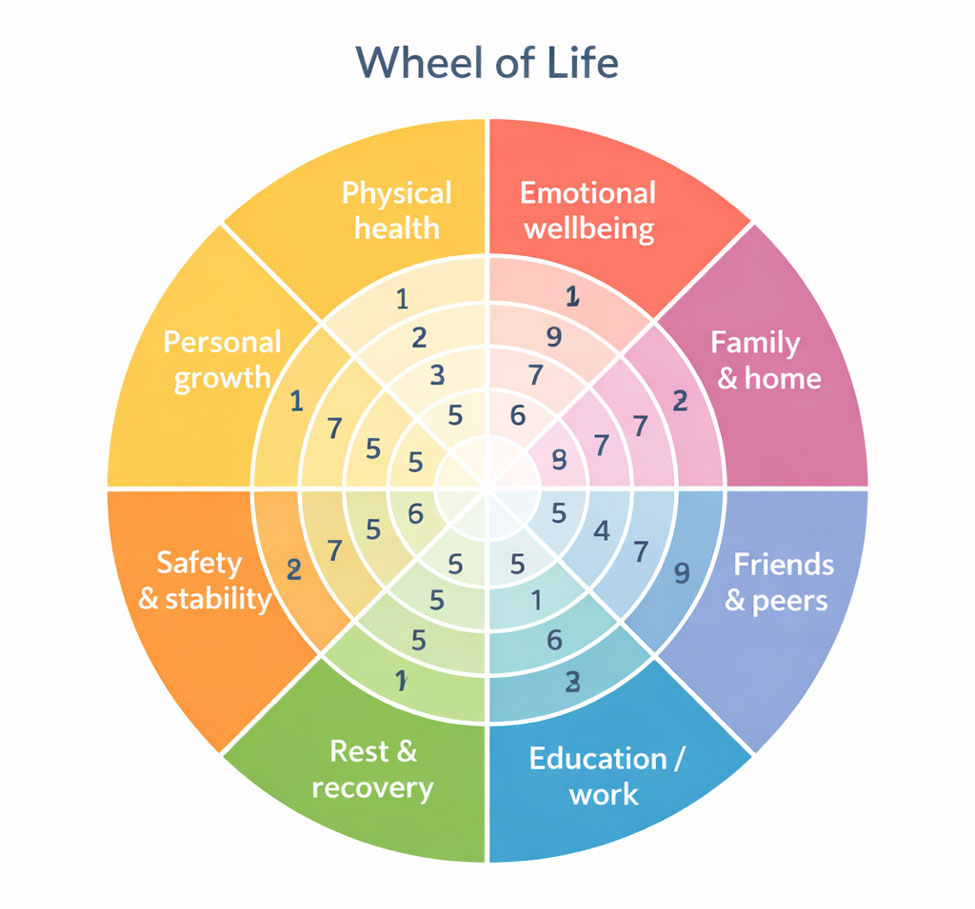
Facilitators may replace or rename domains depending on the group. For example, “learning/ work” may become “school and studies”, while “safety and stability” may become “sense of safety” or “daily stability”.
The Wheel of Life is a review process that divides up our lives into smaller segments which are then easier to assess. In effect we give ourselves marks out of ten in each “life zone” and then draw the score onto the chart. This gives us a visual representation of how we are doing overall and points towards the zones that we can work on. The goal is to make our wheel of life the largest and most balanced circle possible.
Here are the zones:
- Health: How do you take care of your physical and mental health? Think about your energy levels, habits, exercise, sleep and overall wellbeing.
- Relationships: How satisfying are your relationships with others? Consider your ability to connect, communicate and feel supported by people around you.
- Environment: How comfortable and supportive is your physical environment? Think about your living space, surroundings, safety and daily conditions.
- Career: How fulfilled are you in your work or studies? Reflect on your sense of purpose, motivation, growth and work-life balance.
- Money: How well are you managing your finances? Consider your income, spending, savings and overall financial stability.
- Personal growth: How are you developing as a person? Think about learning, self-improvement, new skills and personal goals.
- Brightness of life: How much joy, fun and positive energy do you experience in your daily life? Reflect on hobbies, inspiration and overall life satisfaction.
- Spiritual life: How connected do you feel to your inner self, values or beliefs? Consider meaning, purpose, reflection and inner balance.