

Traffic Lights
Purpose: This tool makes it easy for participants to show how they feel about a particular question or topic in a group setting. As this tool can be used with pictures, colours, or simply gestures (e.g. such as showing a thumbs up or thumbs down), it is very accessible can be used as an icebreaker. Originally, the tool was developed as an ice breaker as part of a programme about financial literacy. Through this exercise, young people can see in a quick and non-judgemental manner how their own views compare to those of their peers. After each question round, facilitators can provide some space for discussion. This enables young participants to exchange ideas, expand their understanding of a given topic, and refine their viewpoints.
Romanian pilot experience: The Romanian pilot highlighted the value of the tool not only as an icebreaker, but also as a safe communication method in groups where participants may hesitate to speak openly from the start. It proved particularly useful for creating a low-threshold entry into discussion, supporting emotional safety, and helping facilitators quickly understand how participants relate to a topic.
Issue addressed: Originally, financially literacy. However, it can be adapted to any topic, including: bullying and violence prevention, stress management and relaxation, and mental health literacy
Relevance to mental health: Participating in the exercise itself can help foster a sense of belonging to peers. This is because it can help participants see how their own worries, fears or perceptions relate to others. Often, participants realise that others share their worries, which can help them feel less isolated. In addition, learning about a particular challenge or topic (e.g. finances, bullying prevention, etc) can strengthen participants’ resilience.
Intended change: Participants feel open, relaxed and ready to participate in a deeper conversation about a particular issue or challenge.
Romanian pilot experience: In the Romanian pilot, the intended change was broader than simply preparing participants for discussion. The tool supported young people in expressing opinions and emotions in a safer, lower-pressure way, especially when verbal participation felt difficult or intimidating. It helped participants experience that their views could be expressed and acknowledged even without speaking, which increased confidence, reduced performance anxiety, and encouraged more open and respectful communication within the group. The activity also supported participants in becoming more aware of how clarity of expression and carefully formulated questions influence understanding and reduce misinterpretations.
Context of pilot implementation
This tool was piloted in three countries as part of the MEET project. These included Austria, Slovenia and Romania. The Austrian partner JIT worked with 12–23-year-old young people through open youth work and street work activities. The objectives of the pilot were supporting participants’ self-esteem, teaching about healthy body image, raising awareness about bullying, managing stress and anger and promoting empathy and emotional safety. The Slovenian pilot was carried out with pupils aged 13–14 in primary schools (9th graders). The focus of the pilot in Slovenia was on developing emotional literacy and empathy, addressing stress and anxiety, critically reflecting of media influence and body image, and improving communication and peer relationships.
Romanian pilot experience: The Traffic Lights tool was also piloted in Romania in two different educational contexts: at CSEI “Christiana” Bocșa, in an inclusive education setting with students with special educational needs, and at Mathias Hammer High School in Anina, with high school students aged approximately 14–16. The sessions involved groups of 15 and 24 participants and were facilitated in person by a licensed psychologist with support from project team members. In both Romanian sessions, the tool generated high engagement and was perceived as easy, enjoyable, and safe to use. Participants appreciated the possibility of answering questions through coloured cards instead of speaking, especially when the questions were more personal. Facilitators observed that the non-verbal format reduced pressure, supported participation from quieter students, and created a strong sense of safety and openness in the group. The Romanian pilot also showed that the tool is particularly effective in mixed or vulnerable groups, including students with special educational needs, because it enables equal participation without requiring immediate verbal self-disclosure. At the same time, some participants wanted to elaborate verbally after voting, which showed that the activity can function not only as an icebreaker, but also as a bridge toward deeper group discussion when facilitated with flexibility. In all three countries, the Traffic Light tool was used as emotional check-ins between the sessions. while the Slovenian and Austrian teams also used it as a way to share opinions on taboo topics. It proved especially valuable for enabling participants to express their views without the immediate influence of group dynamics or peer pressure. By allowing individuals to respond non-verbally first, the tool created a safer entry point into discussion, encouraged more honest responses, and supported the inclusion of quieter participants. Facilitators found the tool to be a useful, visual conversation starter. It was also seen as a useful tool for encouraging self-reflection and building confidence and openness in small groups. The tool proved especially suitable for groups that included participants with lower confidence in verbal expression, social anxiety, or special educational needs. It was effective both in inclusive school environments and in regular high school settings, particularly where facilitators aimed to create a safe starting point for discussion and encourage participation from students who might otherwise remain silent.
Target group
- Age: 12 years and above
- Profile: any type of youth.
- Context: non-formal or formal education, can be done in small and large groups
- Duration: 20-40 minutes
Context of use
Location: School, NGO, youth centres, community centres, outreach etc. Enough space for movement should be provided.
Types of skills and dimensions addressed:
- Socio-emotional skills: empathy and understanding of stress and anger mechanisms
- Relational skills: open communication, reduction of judgments
- Self-regulation skills: emotional self-regulation,
- Awareness skills: awareness of one’s own emotions and possibilities to regulate them.
- Participatory and expression skills: ability to express one’s opinion independently, without immediate peer influence, and to engage in group discussions in a safe and respectful way.
Romanian pilot experience: The Romanian experience confirmed that the tool is particularly useful at the beginning of sessions dealing with sensitive or personal topics, as well as during the session as a quick check-in or reflection method. It works well in contexts where facilitators need a low-threshold, structured way to assess opinions, emotional comfort, or group tendencies without putting participants under pressure to explain themselves immediately.
Activity description – step by step
Step 1: Preparation
Facilitators should select a topic and prepare statements for the youth participants to vote on (agree, neither agree nor disagree, disagree). There is great flexibility in which topics to choose. Examples include:
Statements / Questions on Body Positivity / Bullying:
- If someone is bullied, that person deserves it.
- If someone is bullied, I take the side of the bullied person.
- If someone is overweight, it is okay to call that person fat.
- Overweight people are lazy.
- What is beautiful is the same for all people.
- Overweight people are themselves to blame for their situation.
- You fall in love with someone’s appearance – everything else doesn’t matter.
- At the swimming pool, it doesn’t matter what you look like – the main thing is having fun.
- Whoever bullies others deserves a punch in the face.
- A man without muscles is not a real man.
- Whoever wants to be thin can achieve it – how doesn’t matter.
- I am free of prejudice toward thin people.
- All bullies are bad people.
- Whoever bullies others is weak themselves.
Facilitators either distribute traffic light props or engage participants in making their own. If materials aren’t available, participants can use their thumbs to express agreement or disagreement. In larger groups, facilitators should also plan to make multiple small groups and decide on who joins which group. Where possible, it’s good to ensure that groups are diverse.
Slovenian pilot experience: During the session on media influence in Slovenia, participants responded to statements related to distinguishing between AI-generated and real content (e.g. “I can almost always tell if something is AI-generated” or “What I see online is usually realistic”). This initial voting phase encouraged critical thinking and revealed participants’ assumptions. It was followed by a video showcasing a mix of AI-generated and real visuals, which allowed participants to compare their responses with reality and recognize potential misjudgements. This process deepened their understanding of how easily digital content can be manipulated and how it influences both perception and emotional responses. In the body image segment, participants were shown a series of images and asked to indicate whether they perceived each body as “ideal” or not using the traffic light method. After the voting, it was revealed that all of the presented body types had been considered “ideal” at different points in history. This created a strong moment of reflection, helping participants understand how beauty standards are socially constructed, constantly changing, and often unrealistic. The activity also incorporated an emotional dimension, as participants were encouraged to reflect on how these images and discussions made them feel (e.g. pressure, insecurity, confidence, or confusion). This supported the connection between cognitive understanding and emotional awareness, while fostering empathy and openness within the group.
Step 2: Introducing the activity
The facilitator organizes a group of participants in a circle. The activity can be done either sitting or standing. All participants should be able to face each other. The facilitator introduces the activity. If no materials are available, the facilitator demonstrates how participants can use their thumb. At this point, the facilitator also explains some ground rules for interacting. For example, the facilitator explains that there are no right or wrong answers. The purpose of the activity is to learn about others’ viewpoints and to reflect on one’s own.
Step 3: Conducting the activity
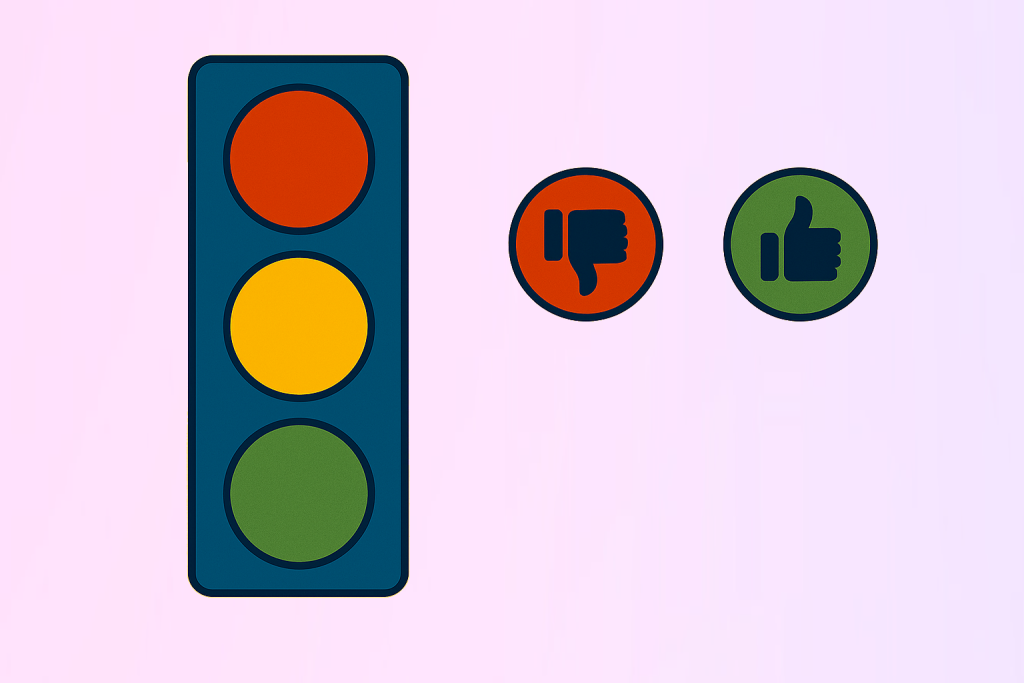
The facilitator will read each question or statement. After each, all participants vote simultaneously by holding up the traffic light with the respective colour:
- Green: YES / agreement / in favour
- Yellow: MAYBE / undecided / uncertain
- Red: NO / rejection / against
After each vote, participants can explain their choices and engage in short discussions. Here, the facilitator should make sure that everyone gets a chance to speak. It is also important to ensure that the atmosphere remains calm and relaxed. The purpose of this activity is to spark ideas which can be discussed in more depth at a later stage. The purpose is also to build connection between participants and to “break the ice”.
Romanian pilot experience: In the Romanian pilot, facilitators observed that the activity became most effective when participants were first allowed to vote non-verbally and only afterwards invited, on a voluntary basis, to explain their answers. This sequencing preserved the low-pressure nature of the tool while still opening space for dialogue. It was also noticed that participants engaged more confidently when the facilitator maintained a calm pace, used clear and direct formulations, and avoided overly complex or negatively phrased questions.
Step 4: Conclusion
Once participants have voted on every statement or question, the facilitator summarizes the main points of discussion and moves on to another activity. The length of the activity can be varied, and the activity can be repeated as useful. However, making the activity to long or using it too frequently could cause participants to lose interest as the “novel” or “fun” aspect of the Traffic Light method wares off.
Required materials:
- Props to represent the Traffic Lights can be used. These can also be made of different coloured papers (green, yellow, red) However, participants can just use their thumbs to gesture agreement or disagreement with a statement made by the facilitator.
- Statements or discussion points that participants can agree, neither agree or disagree, or disagree with.
Impact Evaluation of the Activity
Interviews with the pilot facilitators in the MEET project highlighted that as an introductory activity, Traffic Lights was widely perceived as an effective and low-threshold icebreaker. Its non-verbal, colour-based format enabled participants to express opinions or emotional states without the pressure of verbal explanation, which facilitators found particularly valuable in newly formed groups or contexts marked by initial hesitation. Beyond its use as an icebreaker, Traffic Lights was also applied as a recurring check-in or reflection tool during sessions addressing bullying, stress, group norms or decision-making, allowing facilitators to quickly gauge group dynamics and individual comfort levels. The tool can also be adapted based on the group’s reaction, which helps maintain a positive atmosphere.
Romanian perspective: The Romanian pilot confirmed that the Traffic Lights method is an effective introductory and reflective tool, particularly for groups that need a sense of safety before engaging in open discussion. Facilitators observed high levels of engagement in both sessions where the tool was used. Participants reported that the activity felt easy and enjoyable, and several expressed the wish to continue beyond the planned time. The method was especially valuable in reducing communication pressure: participants could answer without speaking, which made it easier for them to express views on personal topics and helped reduce performance anxiety. At the same time, the pilot showed that the discussion component benefits from flexible moderation. Allowing a short, optional time for verbal elaboration after each round helped balance structure and spontaneity, while keeping the activity accessible and inclusive. The Romanian experience also highlighted that clearly worded statements are essential, as negatively phrased or more confusing questions required extra attention from participants.
Trainer's reflection
Romanian pilot experience: Facilitators observed that the atmosphere remained calm and positive throughout the activity, and that participants became increasingly comfortable as the session progressed. The non-verbal format supported inclusion and reduced hesitation, especially among students who were less confident speaking in front of peers. The facilitators also noted that modelling openness by participating in the activity themselves helped strengthen trust and encouraged more authentic engagement from the group.
Slovenian pilot experience: The level of engagement was generally high, particularly due to the simplicity and interactivity of the Traffic Light method. The non-verbal format (raising coloured cards) allowed all participants to take part simultaneously, including those who are usually less vocal. Engagement increased further when the activity was followed by discussion, especially in moments where participants realised discrepancies between their assumptions and reality (e.g. AI vs. real content, changing body ideals). Images and videos that we combined with the Traffic light activity made the process more interactive and interesting for the students. The activity contributed to a safe and inclusive atmosphere. The use of visual and low-threshold participation reduced pressure on individuals and created a sense of shared experience within the group. At the same time, it helped to establish a respectful space where different opinions could be expressed without immediate judgment. In later stages of the activity, the atmosphere became more open and reflective, with participants showing greater willingness to share their thoughts.
Range of emotional reactions:
A wide range of emotional reactions was observed. These included curiosity and amusement (especially during the AI recognition activity), surprise and disbelief when participants realised their misjudgements, and more reflective emotions such as insecurity or relief during discussions on body image. The activity also triggered moments of recognition, where participants connected the content to their own experiences. Overall, the emotional responses supported deeper engagement with the topics and opened space for meaningful discussion.
Austrian pilot experience: The trainers perceived a high level of motivation among the young people. Through active participation, the method was well suited to create a mood picture within the group. Through the cards in the three different categories, it was also possible to visually capture the opinions in the group, which further reinforced the result; nonetheless, no one had to speak up in order to participate. One strength of the method is its simplicity and at the same time its expressiveness and inclusion of both loud and active as well as quieter, more introverted participants.
Reactions observed during the pilot activity
Romanian pilot experience: Participants in the Romanian pilot showed high engagement and responded very positively to the Traffic Lights method. Many described it as easy, enjoyable, and comfortable to use. In both pilot settings, participants appreciated that they could answer questions without having to speak, which made the activity feel safer, especially when the questions touched on more personal experiences or opinions. In the inclusive education setting, the method proved especially effective because all participants could take part equally and safely, regardless of their confidence in verbal communication. In the high school group, the activity generated strong interest and curiosity, with students wanting to continue even after the planned end of the session. At the same time, some participants wanted to explain their answers verbally after voting, which showed that the activity not only supports low-threshold participation but can also stimulate deeper discussion. Facilitators also observed that certain statements, especially negatively phrased ones, required more concentration and could create confusion if not formulated clearly.
Slovenian pilot experience: Participants responded positively to the Traffic Light activity, particularly appreciating its interactive and accessible format. The visual and non-verbal nature of the tool made it easier for students to express both their emotions and opinions, including in situations where they might otherwise hesitate to speak. It proved especially effective in reducing the immediate influence of group dynamics, as participants could first respond individually before engaging in discussion.
The activity successfully stimulated reflection and discussion, particularly when followed by revealing information (e.g. distinguishing between AI and real content or uncovering changing body ideals). These moments often led to surprise and reconsideration of initial beliefs, supporting critical thinking and emotional awareness.
At the same time, the activity highlighted the importance of guided facilitation. Some participants initially followed the majority or were unsure about expressing differing opinions, which required encouragement to reflect independently. With facilitation, however, participants became more confident in sharing their perspectives and engaging in respectful dialogue.
Austrian pilot experience: Sometimes young people make fun of the exercise and question the individual statements. But even with these reactions, participation and reflection can be encouraged. It is important that the participants also enjoy the exercise in order not to lose interest. This exercise manages well that young people participate and stay with the topic for a longer period of time.
Risks and warnings
Depending on the chosen topic, some strong emotions or feelings could surface. Therefore, it is important that the facilitators set the stage, emphasising kindness, respect and that all answers are welcomed. Otherwise, this is a very safe and accessible activity.
Romanian pilot experience: In the Romanian pilot, the main practical risks were not emotional overload, but rather loss of structure when participants became very eager to elaborate after each vote. Facilitators should therefore balance openness with time management and keep the rhythm of the activity clear. It is also important to formulate statements in a simple and direct way, as questions with double negation or ambiguous wording may confuse participants and reduce the effectiveness of the exercise. Where needed, facilitators can allow brief optional explanations after each vote without turning the activity into an unstructured discussion.
Austria pilot experience: It could be that different opinions clash with each other. A respectful interaction with one another should be maintained, and an open discourse about the topic should be encouraged.