


Emotional Maze
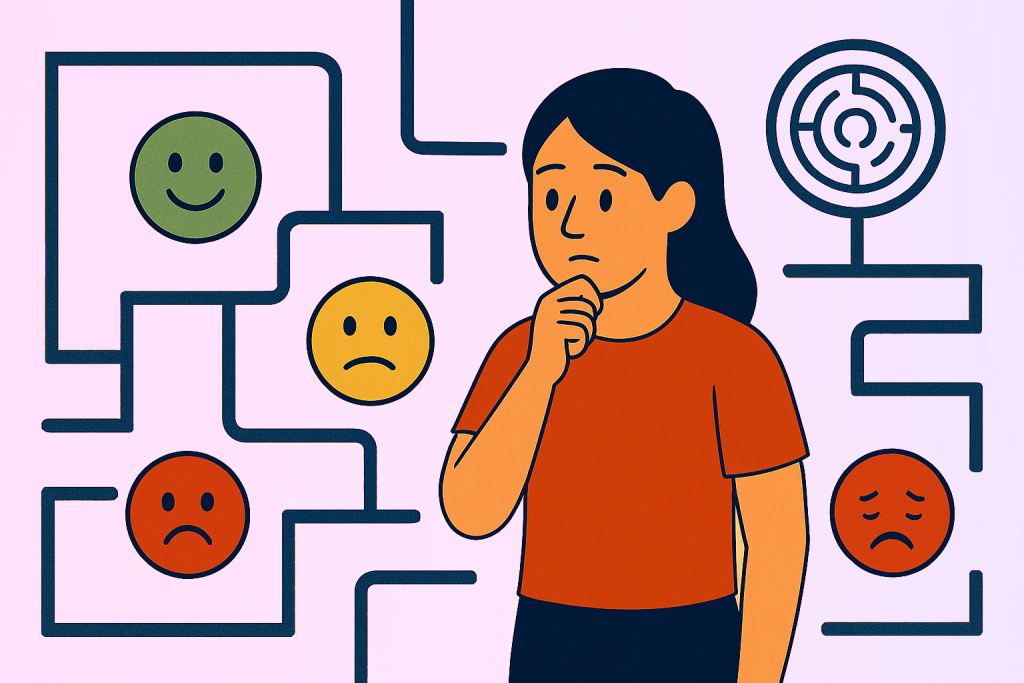
Purpose: The Emotional Maze is about helping you better understand your own emotions and reactions in different situations. It gives you a chance to pause, think, and explore how you usually deal with challenges and maybe discover new ways to handle them.
Issue addressed: Sometimes it’s hard to recognize what we feel or why we react the way we do, especially in stressful or unexpected situations. Many young people don’t really get the space to talk about emotions or practice handling them and this tool creates that space in a simple and interactive way.
Relevance to mental health: Understanding your emotions is a big part of taking care of your mental health. This activity helps you become more aware of your feelings, see how different situations affect you, and realize that others go through similar things too. It also encourages more open conversations about emotions, which can make a big difference.
Intended change: By the end of the activity, the goal is that the participants feel more comfortable talking about emotions, more confident in handling different situations, and more aware of their own reactions. This is not about to give “perfect answers”, but to help young people reflect, share, and build their own ways of coping.
Context of pilot implementation
The session took place in person, with facilitators guiding the process and supporting participants in reflecting on their emotions and reactions. The group consisted of 11 participants (3 male and 8 female).
Theoretical background
The tool is based on emotional intelligence, especially recognising emotions and understanding how they influence our reactions. Instead of only talking about feelings, we go through different situations and reflect on our own responses. This helps make emotional awareness more practical and easier to connect to real life.
Target group
- Age: 13-20 (also adaptable for adults)
- Profile: young people who want to better understand their emotions, including students and youth also with fewer opportunities or from diverse background
- Context: The activity was implemented in a community house for youth in a face-to-face setting. It was carried out as a non-formal, facilitator led group session, in a safe and interactive environment for the young people.
Context of use
Location: Community spaces, youth centres, schools, workshops, or any group setting where participants can safely share and reflect
Types of skills and dimensions addressed:
- Emotional awareness – recognising and naming feelings in different situations
- Self-reflection – thinking about personal reactions and experiences
- Emotional regulation – exploring different ways of handling challenging situations
- Decision-making – choosing between different responses and understanding their consequences
- Communication – sharing thoughts and listening to others in a group setting
Activity description – step by step
Step 1: Introduction - How the game works
Duration: 15 minutes
Procedure: We start with a short intro about emotions and explain that the activity is basically a “maze” of real-life situations. The idea is simple: there are no right or wrong answers, just different reactions.
Table 1. Actions – Step 1.
| Facilitator’s Actions | Participants’ Actions |
|---|---|
| Introduces the topic of emotions | Ask questions if needed |
| Explains the idea of the Emotional Maze | Start reflecting on their own reactions and experiences |
| Emphasises that there are no right or wrong answers | |
| Introduces the different types of cards (scenario, support, obstacle) | |
| Gives simple examples to make the rules clear | |
| Creates a safe and relaxed atmosphere |
Reflection: At this stage, participants are just getting into the topic. Reflection is still light, as they mainly focus on understanding the activity and starting to think about their own reactions.
Step 2: Going through the maze
Duration: 30-40 minutes
Procedure: Participants move through the Emotional Maze step by step. At each point, they receive a scenario describing a real-life situation and decide how they would react. They are encouraged to explain their choices and share personal experiences if they feel comfortable. Support and obstacle cards can influence the situations, adding new aspects to think about. The facilitator guides the process, asks simple questions, and keeps the space open and safe for discussion.
Table 2. Actions – Step 2.
| Facilitator’s Actions | Participants’ Actions |
|---|---|
Guides participants through the activity | Move through the maze step by step |
Gives out scenario, support, and obstacle cards | Read and react to different scenarios |
Encourages participants to explain their choices | Choose how they would respond |
Asks simple follow-up questions if needed | Share their thoughts and personal experiences |
| Keeps the atmosphere open and non-judgmental | Listen and react to others |
Reflection: People actively reflect on their own reactions while going through different situations. They start recognising patterns in how they respond and realise that others may react differently. Real-life connections appear, and sharing becomes more natural within the group.
Step 3: Closing and reflection
Duration: 15 minutes
Procedure: At the end of the activity, participants come together for a group reflection. They discuss their experiences, the situations they found relatable, and the different ways they reacted. The facilitator supports the conversation with simple questions and helps connect the activity to real-life situations.
Table 3. Actions – Step 3.
| Facilitator’s Actions | Participants’ Actions |
|---|---|
| Brings the group back together | Share their thoughts and experiences if they want |
| Asks simple reflection questions (e.g. what felt familiar, what was difficult) | Reflect on their reactions during the activity |
| Encourages sharing, but doesn’t force it | Listen to others and compare perspectives |
| Summarize key takeaways |
Reflection: Participants reflect on their reactions and experiences. They can recognise patterns in how they deal with situations and see that others may think or feel differently. The activity helps them understand their emotions a bit better and feel more comfortable talking about them.
Required Materials: Printed or hand-drawn maze board, scenario cards, support and obstacle cards, markers or small objects for participants, flipchart or paper (optional).
Possible Adaptations
The Maze can be simplified for younger participants by using more relatable and easier scenarios. For older groups or adults, situations can be made more complex or closer to real-life challenges (e.g. workplace or relationships). The maze can also be adapted to a digital format for online sessions. Depending on the group size, it can be done individually, in pairs, or in small teams.
Impact Evaluation of the Activity
| Indicator | Evaluation method |
|---|---|
| Ability to recognize emotions | Participants’ responses to scenario cards and reflections |
| Willingness to share | Examples shared by participants during the game and reflection |
| Understanding of different reaction | Group discussions and comparison of responses |
| Comfort in discussing emotions |
Trainer's reflection
- Level of group engagement: The group was engaged. After a short hesitation, participants became more active and involved, especially during the scenario discussions. It took time to understand the game.
- Atmosphere: The atmosphere was not immediately open. At first, participants were more cautious and less willing to share. However, once a sense of trust was established, they became more comfortable and started opening up.
- Range of emotional reactions: Once participants felt more at ease, they were able to recognize and talk about different feelings, and some connected the scenarios to their own experiences.
Reactions observed during the pilot activity
At the beginning, participants were a bit unsure and more quiet, especially when it came to talking about their feelings. Some needed a bit more time to understand the task and feel comfortable speaking. As the activity went on, they started to open up more. They reacted to each other’s answers, sometimes agreed or added their own examples. There were moments of recognition when they realised they had similar experiences or reactions. By the end, more participants were willing to speak, and the group felt more relaxed. You could see that they were thinking about their own reactions more consciously, not just answering quickly.
Risks and warnings
- Some scenarios may trigger sensitive emotions
- Participants may feel uncomfortable sharing
- Younger participants may need clearer explanations
- Facilitator should ensure a safe, non-judgmental space.